
Forty-eight reports a day instead of twenty. One evening hour to approve them.
White paper · free
What AI Tests
in Your Rules
Ten questions for introducing AI, seen from the organization.
Report 30: the wound, in half a sentence
What this is about
AI makes producing cheap. Checking and taking responsibility have not become cheap to the same degree. When the volume of drafts, reports, and proposals rises, the work does not disappear. It moves to whoever signs last, without anyone having decided it should.
Most AI policies settle who is responsible. They rarely ask whether that person can carry the load where it lands, with the time, access, and authority actually available there. This white paper treats AI adoption as a test of an organization's rules: ten questions, each with a measure.
A set of rules holds only if it promises no more checking than people can deliver.
The white paper
Free
No paywall, no sign-up. Made to be passed on: unchanged, with attribution, for noncommercial purposes.
PDF 23 pages CC BY-NC-ND 4.0 As of October 1, 2026
Read the white paper (PDF) 0.5 MB
Ten questions AI asks of your rules
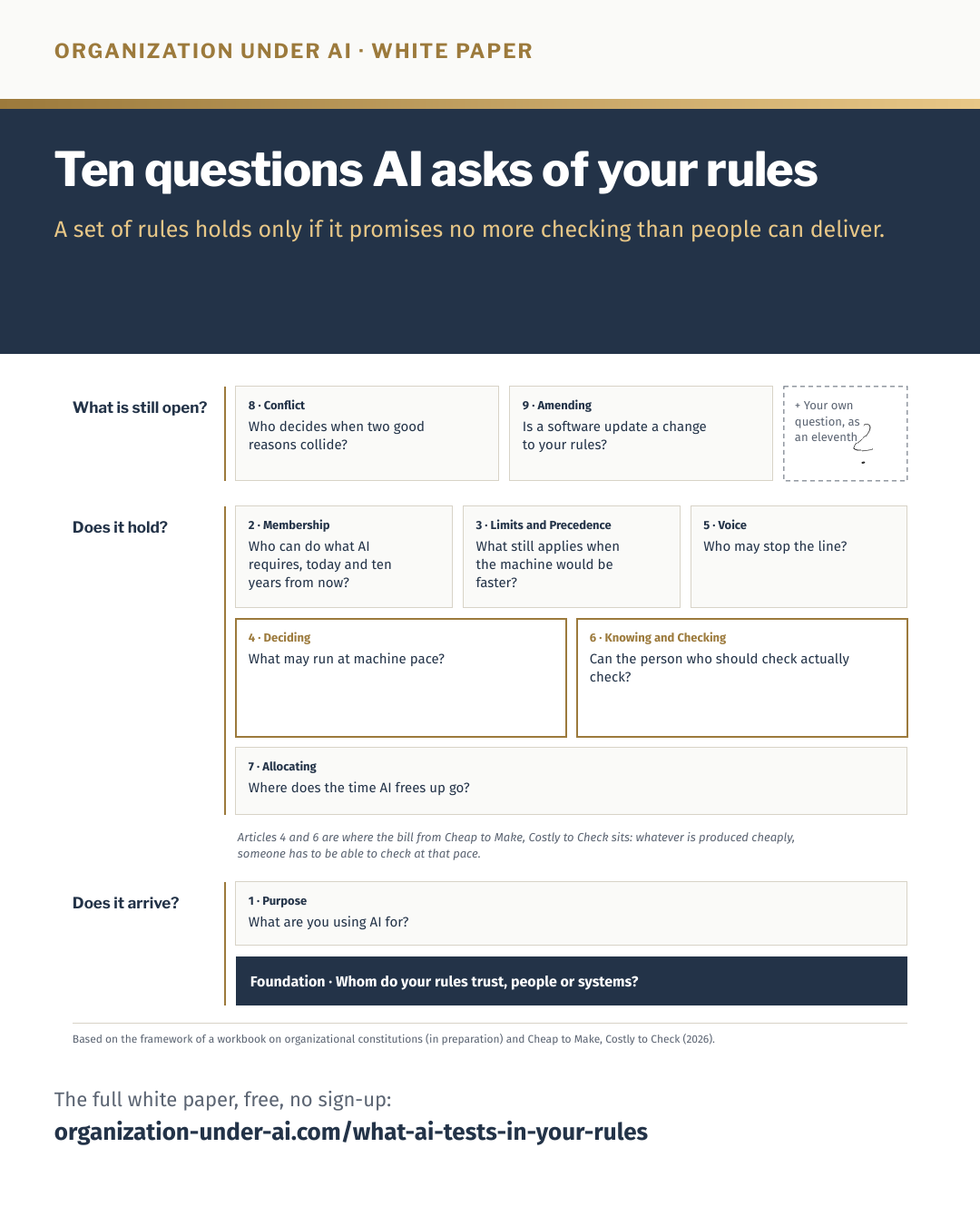
The questions
Grouped under three questions that come before any organizational analysis: Does what was intended arrive where the work is done? Does it hold there? And what is still open? Below, you can count them through for your own organization.
For each question, the white paper gives a case, guidance for the rollout, and a measure. It adds six anchors for every rollout, a roadmap for the first three and the first ninety days, and a dated section on the legal picture.
Count for yourself
Go through the ten questions for your organization. Check only what you can answer today with a name or a number. “Roughly” does not count.
Who it is for
- Owners and executives. Before an AI rollout is decided, or after it has started running without anyone deciding it.
- Employee representatives. With the points where co-determination applies to AI, and a warning against measuring performance from system logs.
- Compliance, boards, and oversight. With the question of whether a planned check actually takes place.
The legal section is dated October 1, 2026, including Regulation (EU) 2026/1744. Later changes are tracked on the law page for Volume One.
Further reading
The mechanism behind Articles 4 and 6, with every source, the counter-evidence, and the worksheets, is in Cheap to Make, Costly to Check, Volume One of the series. A short version is free as a PDF.
A workbook on organizational constitutions is in preparation.
All advisory formats run online. To talk about your organization: guidobosbach.com/en/contact.